The European Commission has published a new report on Research & Innovation Projects

The European Commission, DG Research and Innovation has published a new report on Research & Innovation Projects called “A Just and Inclusive Green Transition”


This report assesses 55 EU-funded research projects, examining their contributions to a just and inclusive green transition.


The main thematic focus of these projects includes

  • Environmental Justice and Social Inclusion,
  • Sustainable Cities and Urban Planning,
  • Bioeconomy and Circular Economy,
  • Energy Transition and Energy Equity, and
  • Climate Policy and Global Cooperation.


The report presents insights from the projects that can inform policies in these areas. It also presents future research needs as identified by the projects.


Hydro4U one of these projects that has been analysed.


European Commission: Directorate-General for Research and Innovation, Fuoco, T., Mirpourian, M. and Colah, T., A just and inclusive green transition – Report on research and innovation projects, Publications Office of the European Union, 2025 https://data.europa.eu/doi/10.2777/6222808

On a path to strengthening transboundary tributary governance in Central Asia for better Nexus outcomes

September 23, 2024

IWMI is leading Hydro4U project activities related to accountability and benefits sharing in the context of the Water-Food-Energy-Climate (WFEC) nexus in Central Asia. While several important milestones have already been achieved, our ongoing activity related to the co-development of integrated cross-border policies for sustainable benefits sharing at tributary level in Central Asia may be of interest to a very broad audience.


Since the dissolution of the Soviet Union, much focus in Central Asia has been placed on developing and strengthening institutional setup at the full basin level. Small tributaries, however, key places for introducing small hydropower (SHP) solutions, continue to receive less attention. Through stakeholder interviews and review of literature, IWMI researchers have determined that only a handful of small transboundary tributaries (STTs) are covered by cross-border agreements while the majority are not. Moreover, even stakeholders in STTs that are covered by agreements think that the agreements can be strengthened or updated. The reason for that being that existing STT level agreements are not sufficient to address changing water supply and demand dynamics between the Kyrgyz Republic and Uzbekistan. For instance, Shakhimardansai which is selected as one of the demonstration sites under Hydro4U is covered by a Soviet-era agreement: Protocol on decadal water allocation in Sokh, Shakhimardan, and Isfayram between the Uzbek and Kyrgyz SSR from June 14, 1981, which specifies decadal, percentage-based water allocation for the vegetation period and is considered a follow up to the Protocol on the Interstate Allocation of Ferghana Valley’s Small Rivers’ Flows from the 1980. Both agreements have a narrow scope and are no longer adequate to capture increasing uncertainty of water supply and demand, making new interventions, such as the introduction of SHPs, risky.


To develop a template or a checklist that can help stakeholders to implement sound legal practices in future consultations on transboundary water agreements in Central Asia, IWMI is analyzing climate resilience of legal frameworks covering STTs while also assessing resilience of select number of STTs, like Shakhimardansai, to future climate change-induced water variability. The methods and results of this activity are discussed with key stakeholders to gather their feedback. This collaborative approach ensures that the resulting template or a checklist will be both practical and resilient.

Picture: Meeting and discussing water management challenges in Ferghana Valley with a representative from the Syrdarya-Sokh Basin Irrigation System Authority.
Photo credit: Bunyod Holmatov (IWMI).


Author: Bunyod Holmatov (IWMI)

Website: International Water Management Institute (IWMI)

Press-Release: Hydro4U Project Pioneers Sustainable Small Hydropower Solutions to Unlock Central Asia’s Energy Potential Amid Climate Challenges

27th August 2024


Central Asia holds immense potential for hydropower generation, especially in upstream regions, but outdated infrastructure and limited new developments pose significant challenges, exacerbated by water scarcity and climate change. The Hydro4U project addresses these issues by developing innovative, climate-resilient small hydropower (SHP) technologies optimized for cost-effective and simple implementation in remote areas, while maintaining EU quality and environmental standards. The project partners also introduce advanced planning and assessment tools, engage local communities to enhance socio-economic benefits, and foster partnerships with local companies. This aims to result in sustainable hydropower development and future commercial opportunities in the Central Asian market.


The EU-funded Hydro4U project is now entering the second half of its total project duration and can look back on successful progress phases for preparation and implementation.

During the first 18 months of the project (06/2021-11/2022), Hydro4U partners focused on data collection and building partnerships with key stakeholders in Central Asia. A comprehensive database was created to support future tasks, and the two innovative small hydropower solutions were developed:


  • Francis Container Power Solution (FCPS): to be demonstrated at the Shakimardan Enclave (Uzbekistan) in collaboration with state utility Uzbekgidroenergo.
  • Hydroshaft Power Solution (HSPS): to be demonstrated in At-Bashy, Kyrgyzstan, in partnership with the private company Orion LLC.


Additionally, tools for sustainable hydropower planning and a monitoring system for the water-energy-food-climate nexus were introduced. Efforts were also made to raise public awareness and prepare for the commercialization of the developed technologies.

In the second project period (12/2022-05/2024), the consortium continued to advance site-specific designs and demonstration activities and shared feasibility studies and design plans with local investors and contractors. The procurement and manufacturing and delivery of the equipment of the Francis Container plant in Shakimardan, Uzbekistan, has already led to completion in August 2024 and commissioning is scheduled for the near future.

For the second demo-site, the Hydroshaft Power Solution in Kyrgyzstan, the delivery of the equipment is scheduled for October 2024.

Key achievements in this phase of the project included the identification of sustainable hydropower potential, the development of a transboundary water accounting system and the promotion of replication strategies. Another focus was on capacity building, market analysis and business model development, supported by dissemination and communication activities.


 The current work focusses on the completion and commissioning of the Francis Container Power solution and the implementation of the At-Bashy Hydroshaft Power Solution, but furthermore additional planning sites will be selected. Partners will elaborate two further feasibility studies at these sites to enable replication of our innovative technologies.


Available illustration © SJE. Click on the link or on the QR code to get the overview of the construction works in Shakimardan:

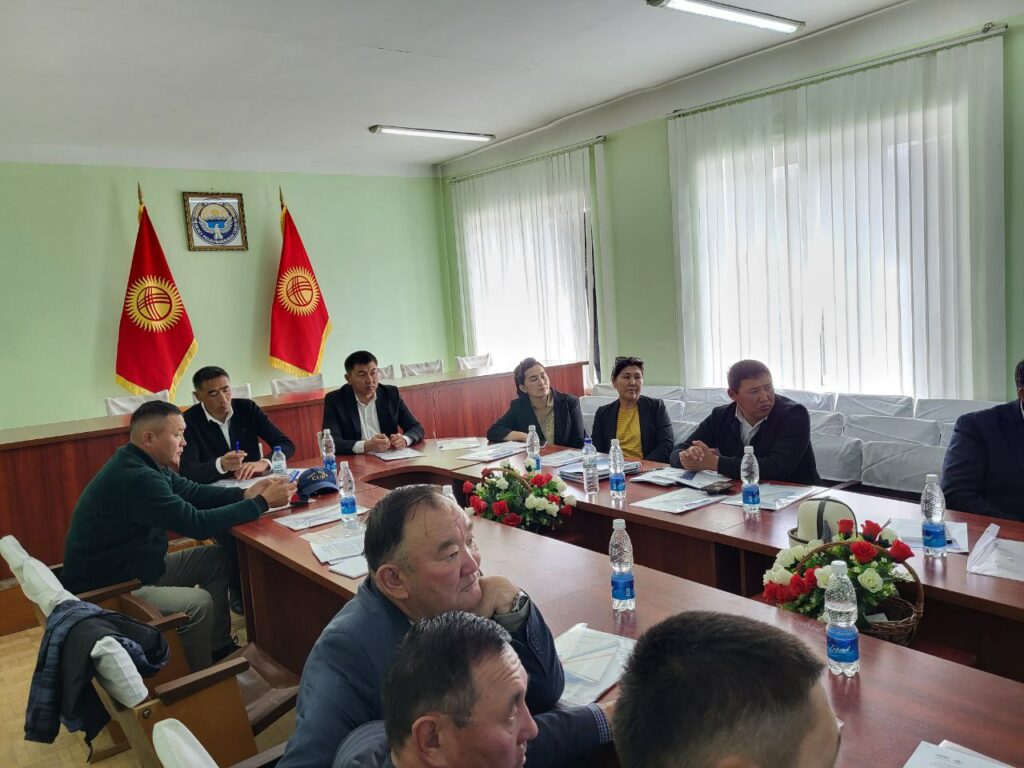
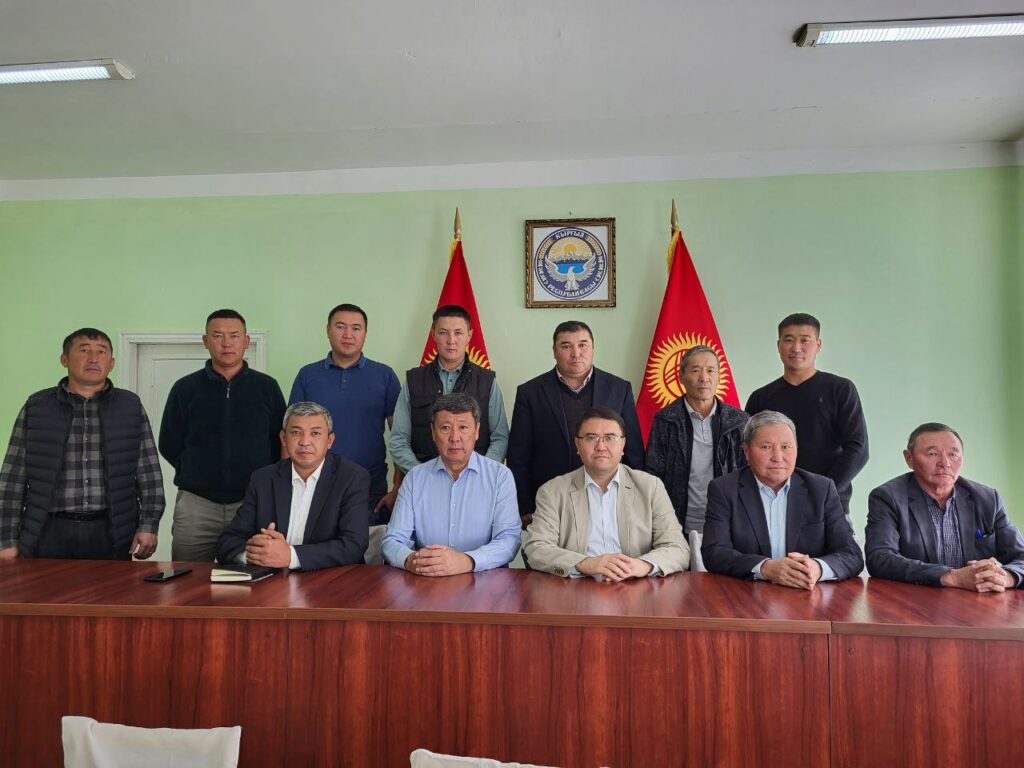
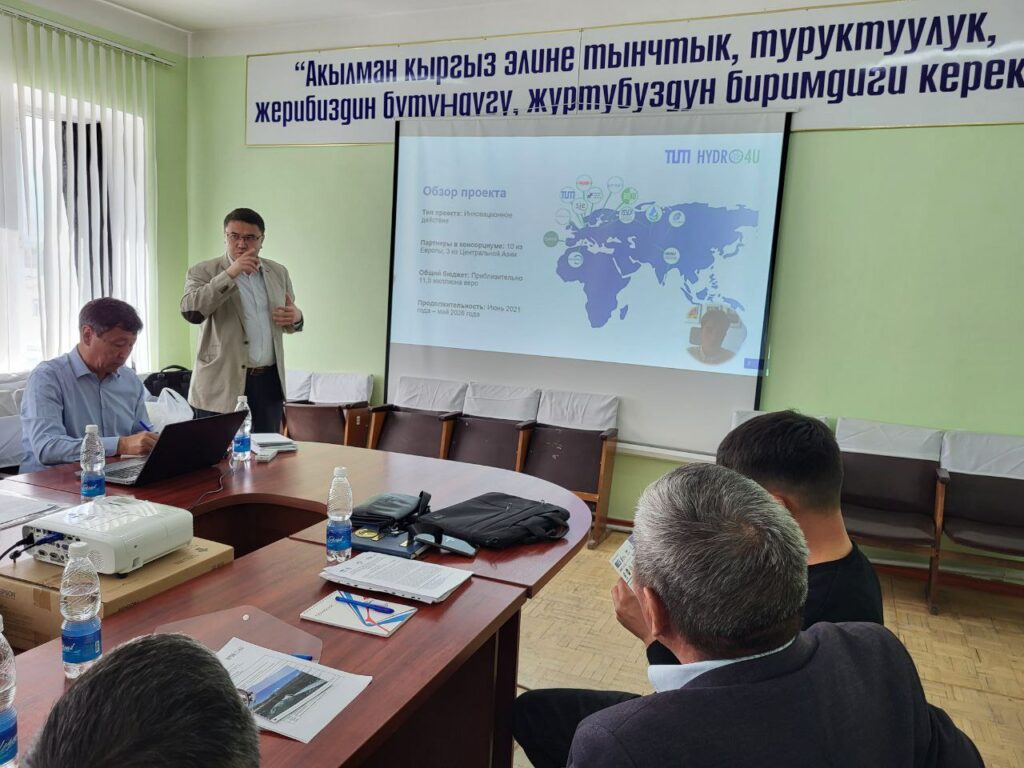
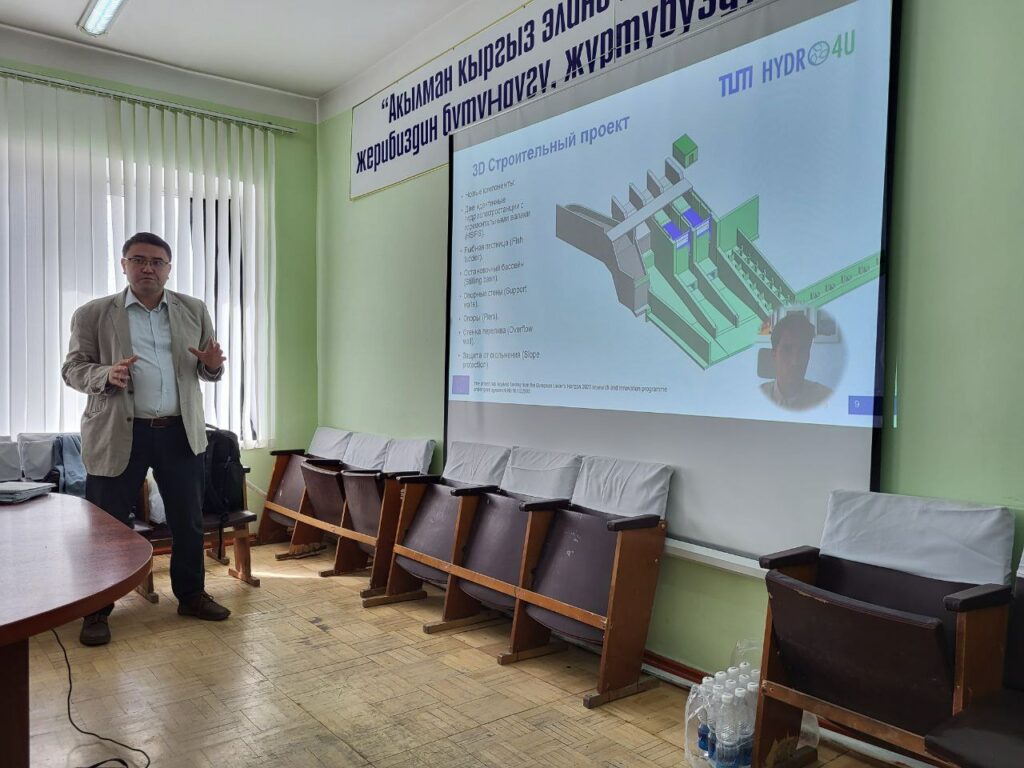
Hydro4U Consultation in At-Bashi, Kyrgyzstan Explores Water Governance and Count4D Tool Deployment

8th September 2023


As part of the EU-project Hydro4U a Stakeholder Consultation was held in At-Bashi, Kyrgyzstan, to foster water governance and deployment of the Count4D tool. The event brought together local and provincial stakeholders to discuss integrated transboundary policies for sustainable benefit sharing, considering the Water-Energy-Food-Climate nexus. The consultation included presentations on shared benefits analysis for small-scale hydropower installations and the innovative Count4D tool for water planning and accounting. Discussions focused on deploying the Count4D tool in Kyrgyzstan, particularly in the At-Bashi district, with feedback from local stakeholders informing future developments.


Read more in our press release: EN


КОНСУЛЬТАЦИОННАЯ ВСТРЕЧА HYDRO4U В АТ-БАШИ, КЫРГЫЗСТАН, ИЗУЧЕНИЕ УПРАВЛЕНИЯ ВОДНЫМИ ВОДАМИ И РАЗВЕРТЫВАНИЕ ИНСТРУМЕНТА COUNT4D


Краткая информация:

В рамках проекта ЕС Hydro4U в Ат-Баши (Кыргызстан) была проведена консультация заинтересованных сторон с целью содействия управлению водными ресурсами и внедрению инструмента Count4D. Мероприятие объединило местные заинтересованные стороны для обсуждения комплексной трансграничной политики для устойчивого распределения выгод с учетом взаимосвязи воды, энергии, продовольствия и климата. Консультация включала презентации по анализу общих выгод для малых гидроэлектростанций и инновационному инструменту Count4D для планирования и учета водных ресурсов. Обсуждения были сосредоточены на внедрении инструмента Count4D в Кыргызстане, особенно в Ат-Башинском районе, при этом отзывы местных заинтересованных сторон предоставили информацию, которая будет использована в дальнейшем.
Picture credits: Oyture Anarbekov, International Water Management Institute (IWMI)

ASIA 2023 / Hydro4U Special Session

14-16 March 2023, Kuala Lumpur, Malaysia


The Aqua~Media International team, with the support of the Malaysian Government, the Malaysian Committee on Large Dams, and the State Power utilities, welcomes the global water and energy community to this event.


Peninsular Malaysia, as well as Sarawak and Sabah, have wide experience of large and small hydropower development and multipurpose dams. Study tours will visit to some of the large cascade developments in Peninsular Malaysia. Hydropower supplies about 20 per cent of Malaysia’s approximately 34 GW of installed capacity, with hydro supplying more than 20 TWh/year. The Government is strongly committed to increasing the share of renewable energy in the country’s generation mix, with a target to add 4 GW of renewables across the thirteen states by 2030.


A major element of the ASIA 2023 event will be the Technical Exhibition, running for three days alongside the conference. The exhibition pavilions will be the main hub for business networking, between delegates and industry representatives who will be exhibiting their supplies and services.


In addition, there will be a Special Session on IEA activities and Hydro4U, promoting small hydro development in Central Asia, chaired by project partner Klaus Jorde, International Energy Agency. The content of this session will reflect the current activities of IEA Hydro, and Hydro4U project coordinator Bertalan Alapfy from the Technical University of Munich will host a session on the support of small hydro in Central Asia. A new element to the session will be papers on Hydro4U (see also Hydropower & Dams, Issue 5, 2022), in which IEA is involved.


Further information: Conference Themes | ASIA 2023 (hydropower-dams.com) and Conference programm: ASIA 2023

Hydro4U presents first ecological results of the Shakimardan case study at the 36th Congress of the International Society of Limnology in Berlin

On 8th August 2022, Hydro4U partner Bakhtiyor Karimov (TIIAME NRU) presented first ecological results of the Shakimardan case study at the 36th Congress of the International Society of Limnology (SIL) in Berlin, Germany. Moreover, Hydro4U partners TIIAME NRU, INBO and BOKU IHG have published a related conference proceeding titled ”Biodiversity and anthropogenic impacts on fishes of Shakimardan River drainage, Ferghana valley, Central Asia”.[1]


In Central Asia since 1960s, many of native fish species were lost or extremely declined in population size and distribution area. Many previously common fish species are hard to find today. Therefore, the last International Union for Conservation of Nature (IUCN) assessment has estimated more than one third of fish fauna in the region as data deficient. Since 1960s, Central Asia has developed large-scale irrigated agriculture with a multitude of hydro-technical infrastructure and diversion. Only in Uzbekistan, a total length of the inter-farm and on-farm irrigation networks amount to 27,868 km and 154,957 km respectively (which is four times the length of the Earth’s equator).


Shakimardan River drainage, Ferghana valley, Central Asia


The Koksu river is characterised by an upstream natural sediment dam, which was caused by a massive earthquake in the XVI. century. After the emergence of the dam, the large lake Kurbankul was formed at an altitude of about 1,725 m a.s.l. The lake is fed by the melting of snow and glacier and supplies the downstream Koksu River with water by draining through the sediment dam.


The Shohimardonsoy (Shakimardan) river basin is located in the territory of Kyrgyzstan and Uzbekistan (Shakimardan enclave). The Shakimardan River is formed by the confluence of the Aksu and Koksu rivers. Most of the 1,300 km² large basin is high mountainous and the length of the river is 112 km.


River ecology and fish migration barriers surveys


The Shakimardan River drainage features over ten barriers, particularly in its middle and downstream reaches, many of them being fully impassible for upstream migrating aquatic biota.


Fish Diversity and Migration Studies


The Shakimardan river drainage was connected to the Syrdarya River until the 1960s. Until this time, potamodromous fish species from downstream parts were likely able to swim upstream into Shakimardan river and its tributaries. However, starting in the 1960s, development of intensive water extraction for the cotton monoculture has led to transformation of the riverbed and instream connectivity. Present studies have revealed that today, many water distribution facilities and dams form unpassable barriers for fish and fragmentation of previously connected rivers and river sections.


Sampling sites


At the 2022 spring field trip, BOKU IHG and TIIAME NRU sampled 21 sites consisting of 41 mesohabitat units (i.e., pool, riffle, run, ruffle, pocket pools, cascade, or combinations thereof) with backpack electrofishing gear (Honda FEG 1500, 1.8 kW). In detail, they sampled 9 sites in Koksu river (distributed from the source to its mouth), 3 sites in Aqusu river, 7 sites in Shakimardan river (4 in the Uzbek mainland close to the town of Vodil, 3 in the enclave of Shakimardan) and 2 sites in downstream diversion channels to gain a better understanding on fish biodiversity, distribution and population status in the basin. Electrofishing was not permitted in the river section of the Kyrgyz Republic.


CONCLUSIONS


The sustainability approach of the small hydropower construction demands that habitat connectivity for fish in Koksu river is ensured. Therefore, the following key tasks are needed:


  • The environmental flows allocation must provide minimum depths to enable fish migration.


  • The artificial barrier (waterfall) located in the future environmental flows stretch needs to be re-constructed to ensure fish migration


  • The hydropower plant must be equipped with a fish pass and downstream migration solutions


In both cases, nature-like or technical solutions are viable options. In general, the former is preferred from a fish ecological perspective over the latter as nature-like migration facilities may also constitute better usable habitats for riverine fish.


Areas of necessary action therefore include:


  • protecting free-flowing rivers and critical habitats


  • restoring habitat connectivity and ecological water flows


  • halting over-exploitation of freshwater species and preventing the spread of invasive species


Authors: Bakhtiyor Karimov, Erkin Karimov, Bernhard Zeiringer, Johan Coeck, Daniel S. Hayes


[1] Karimov, B., Karimov, E., Zeiringer, B., Coeck, J., & Hayes, D.S. (2022). Biodiversity and anthropogenic impacts on fishes of Shohimardon River drainage, Ferghana valley, Central Asia. 36thCongress of the International Society of Limnology (SIL), 7-10 August, Berlin, Germany.

The pictures show:


  • Fish migration barrier at Vodil Village, Shakimardan River (pictures 1-3)
  • Snow Trout from Shakimardan River
  • Shakimardan River


picture credits: Daniel Hayes (BOKU IHG), Bakhtiyor Karimov & Erkin Karimov (TIIAME NRU)

Hydro4U contributes to KSTU Summer School 2022

September 29, 2022

The second edition of the Summer School on “HydroKG Kyrgyzstan – hydropower, ecology and hydromorphology” for international bachelor and master students was hosted by Hydro4U project partner Kyrgyz State Technical University named I. Razzakov (KSTU) in Kyrgystan during two weeks in August and September 2022.


Hydro4U aims to bring together stakeholders from industry, politics and science from both Central Asia and the European Union to contribute to a sustainable and climate-resilient future for the region by demonstrating European small hydropower equipment and technologies.


Moreover, one of the objectives of the Hydro4U project is to develop academic programmes and courses on sustainable hydropower for students.


In this regard, KSTU, as one of the partners of Hydro4U project, annually holds a two-week Summer School for students. This programme was already developed jointly by KSTU and the Technical University of Munich (TUM) in 2019. The Summer School is mainly funded by the German Academic Exchange Service (DAAD).


From 20th August to 5th September 2022, students from Germany, Argentina and Kyrgyzstan visited hydroelectric power plants in the south and north of Kyrgyzstan and learned about the environmental consequences and sustainability associated with ecology and hydromorphology, as well as the hydro-electro-technical part of the stations.


The Summer School was led by Ms. Venera Baichekirova, head of the international department of KSTU. From the technical side, it was supported by Professor Nuridin Niyazov from KSTU (Karakoel site), by Hydro4U project partners as well as by IWMI-CA (Uzbekistan office).


The main programme of this year’s Summer School consisted of lectures and seminars at KSTU, combined with field trips to interesting places related to hydropower in the Kyrgyz Republic, small hydropower plants and natural river systems. Russian language courses were also organised teaching technical terminology. Moreover, cultural excursions to the mountainous regions and museums of Kyrgyzstan were offered.


Seminars were held by:


  • Muktarbek Kubat “Perspektive und Entwicklung erneuerbarer Energiequellen” (engl. Perspective and development of renewable energy sources), “Wasser Ressourcen und Management in Zentralasien” (engl. Water resources and management in Central Asia),
  • Saida Usmonova “Sustainable small-scale hydropower potential in Central Asia and role of Water-Energy-Food nexus” and
  • Abdikhamid Urazkeldiev “Hydro4U project: case study of Water-Energy-Food nexus assessments from demonstration sites”.


The students received explanations about the ecological and agricultural background of Central Asia and painted a picture of future challenges of the region. They also visited the Orto-Tokoi reservoir on Issyk Kul’e (led by Mr. Nurbek Sadygaliev), where they received a lot of information about irrigation in Central Asia.


This Summer School offered again an exciting programme for students, professors and experts, who had the opportunity to gain new knowledge and share information about Central Asia as well as to get to know a new culture and an amazing country like Kyrgyzstan.


The organisers would like to thank the partners of the Hydro4U project for their contribution to this year’s Summer School.


Author: Venera Baichekirova, KSTU


Partner description: KSTU

Website: https://www.kstu.kg/

Facebook: KSTU

YouTube: KSTU

Photo credits: Venera Baichekirova, KSTU

Hydro4U project discovers fishes in Koksu River
(Shakimardan enclave, Uzbekistan) for the first time

JULY 22, 2022


Until now, no one thought there were fish in the Koksu River located in Shakimardan enclave, Uzbekistan. Also, until today, no literature information on fish catches in this river was registered. This is due to the lack of up-to-date information on aquatic ecology as well as fish biodiversity and migrations in Central Asia. Also, modern techniques for fish ecology studies were missing.


Within Hydro4U project, scientists from the TIIAME NRU team led by Prof. Bakhtiyor Karimov have conducted intensive aquatic ecology studies and for the first time in history, have revealed the presence of two fish species there: snow trout (Schizothorax eurystomus Kessler, 1872) and one loach species (Triplophysa sp.). During a fieldtrip for river ecology studies in the area of the potential small hydropower plant in November 2021, 24 specimen of snow trout of different ages were caught in the midstream of the river above Shakimardan Village, as well as more than 10 snow trout and loach specimen within Shakimardan Village in April 2022, thanks to the employment of electrofishing equipment introduced by Hydro4U project partners.


The caught fish species could serve as indicators for river ecology. Their habitat requirements serve as a basis for habitat studies and ultimately for achieving the goal of implementing environmentally friendly hydropower solutions.


The “Tashkent Institute of Irrigation and Agricultural Mechanization Engineers” National Research University (TIIAME NRU) is a regionally recognised academic and research institute known for its top programmes in engineering (irrigation, water resources, ecology and environment, electrification & automation, agricultural mechanisation, land management and agricultural economics / management & marketing).


In Hydro4U, TIIAME NRU’s core activities are to depict the impact of small-scale hydropower on aquatic and fish ecology in mountain ecosystems and to lead the preparation and dissemination of open-source educational materials.


Author: Prof. Dr. Bakhtiyor Karimov


Partner description: TIIAME

Website: https://tiiame.uz/

Instagram: tiiameofficial

YouTube: TIIAME

Facebook: Tashkent Institute of Irrigation and Agricultural Mechanization Engineers

Twitter: @tiiameofficial

Images:


1) The snowtrout caught at “Chuqursoy” in Shakimardan village

2) Fish species – Triplophysa sp. from Koksu river, April 2022

3) Koksu river, Shakimardan Village

Hydro4U – European project on sustainable small-scale hydropower in Central Asia meets in Tashkent, Uzbekistan

22.06.2022


Hydro4U is a project funded under the European Union’s Horizon 2020 research and innovation programme. Organisations from Europe and Central Asia are collaborating to boost sustainable small-scale hydropower in Central Asia. Eco-friendly hydropower solutions will be implemented in two demonstration plants: one in Kyrgyzstan and one in Uzbekistan. Further sites in Central Asia will be selected as planning sites. This week, the consortium met for two days in Tashkent for a general project meeting together with the project’s Advisory Board team to review the activities of the past twelve months and plan the upcoming actions. The meeting also included a special session with regional EU Delegations to benefit from the expertise of the Commission.


Read more in our press release: EN, RU, UZ

 Boosting the replication of European Small-hydropower solutions in Central Asia

JUNE 14, 2022


Central Asia is a singular region in terms of Small Hydropower (SHP) development. Although the zone has the second largest SHP potential (up to 10 MW) in the world with 34.4 GW, it is the area with the lowest percentage of SHP development, with only 0.8% of SHP exploited so far.[1]


Behind these low figures, there is a great number of political, economic, social, technological, legal and environmental barriers. There are common issues as the lack of information on SHP or the lack of private sector funding. Moreover, some Central Asian countries have to deal with extreme weather conditions which negatively affect hydropower development, as for example in high altitude regions where streams are likely to freeze in winter.


Hydro4U aims to boost European SHP industry by adapting existing European high-quality solutions to the demands and resources of Central Asia. Furthermore, in order to accelerate the exploitation of these solutions, a replication strategy is being elaborated.


CARTIF is a technology Centre with more than 25 years of experience in the development of renewable energy projects and in the definition of strategies for energy transition. In the context of Hydro4U, CARTIF is leading the replication activities. A key point of our work will be the development of a replication guideline tool, aimed at future investors or public authorities to support decision-making on new SHP projects in Central Asia. The tool will be based on a computational model integrating GIS information and statistical data and will be implemented at river basin level.


Currently, it is planned that the tool will consist of several interactive modules, aiming to (1) visualise the total sustainable HP potential and installed capacity, (2) simulate hydropower (HP) generation scenarios considering Water-Food-Energy-Climate Nexus constrains, sustainability of resources and socio-economic impacts and (3) provide HP technology recommendations as well as lessons learnt related to the implementation of new HP projects.


The tool is intended for public use and is therefore not only aimed at experts who are familiar with the specific details, but also at decision-makers, investors and politicians.


[1] United Nations Industrial Development Organisation. 2019 World Small Hydropower Development Report (WSHPDR)]


Authors: Raquel López, Iván Ramos, Ismael Lozano and Fredy Vélez, CARTIF


Partner description: CARTIF
Website:  www.cartif.es
Twitter: @CARTIFCT
LinkedIn: CARTIF
Facebook: CARTIF
YouTube: CARTIFTV